The Bird Wears a Leaf Now: Chamorro Kitchens Are Rebuilding Thanksgiving From the Inside Out
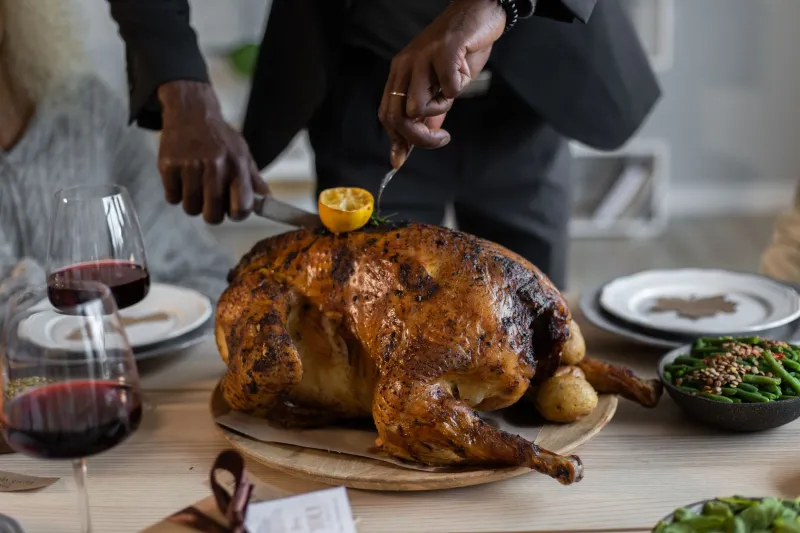
Every November, somewhere between the Costco run and the third phone call about who's bringing what, a small negotiation happens in Chamorro households across the mainland. It's rarely dramatic. It sounds like: You're not putting coconut in the cranberry again, are you? Or: Mom, nobody stuffs the bird anymore, the USDA literally says don't. Or the quiet, loaded one: Tita used to do it this way.
The Thanksgiving table has become one of the most interesting places to watch Marianas food culture work itself out in the diaspora. Not because families are swapping recipes for Instagram points, but because the holiday asks a specific question that island cooking rarely has to answer out loud — what do we keep, what do we change, and who gets to decide?
When the Bird Wears a Leaf
Wrapping turkey in banana leaf isn't a gimmick. It's a workaround with roots. On Saipan, Tinian, Rota, and Guam, leaf-wrapped cooking is ancient and practical: banana and ti leaves hold moisture, carry smoke, and protect food from direct heat. When you're roasting a big bird in a home oven that runs dry and hot, a leaf jacket solves a real problem — the breast stays juicy while the skin crisps at the end.
"My dad would never call it a Thanksgiving technique," says Rita Camacho, who hosts the holiday for about thirty people in San Diego. "He calls it how you cook when you don't want the meat to die twice." The family does a dry brine for two days, lines the roasting pan with banana leaves (found frozen at a Filipino market a mile from her house), and pulls the foil off for the last forty minutes. The leaves char. Nobody minds. "The smell when you open that oven — that's the whole point. That's the thing my kids will remember."
The leaf does something else, too. It makes the bird legible. A cousin who married into the family and grew up in Ohio sees a wrapped turkey and asks a question. That question turns into a story about Saipan, and the story turns into a second helping.
Dressing Is Where the Arguments Live
If turkey is the diplomacy, dressing is the politics. Mainland families split into camps roughly along generational lines. There's the traditional bread dressing wing, often the oldest aunties, who view the holiday as a treaty with the in-laws. And there's the red rice wing — usually the second generation — who cook achote-stained rice with bacon, onion, and enough pepper to make a point, then fold it into the bird's cavity or bake it alongside in a casserole dish.
"The first year I made red rice stuffing, my mom watched me the whole time like I was defacing a monument," says Danny Taitano, a school counselor in Kent, Washington. "Then she had two plates and told me the achote was too light. That's her version of a compliment."
What's notable is that nobody describes this as fusion. Fusion implies a finished product, a menu item, a chef's idea. What happens in these kitchens is closer to translation — the same instinct for salted, sour, savory depth, expressed with whatever the mainland grocery store had on the shelf. Red rice stuffing isn't Chamorro food pretending to be American. It's a family deciding that the dressing should taste like the rice they grew up on.
Gravy With a Backbone
Finadene usually shows up on the table as a condiment, but a growing number of home cooks are putting it in the gravy — soy sauce, cane vinegar, lemon, diced onion, and a minced boonie pepper if someone smuggled one in or grew one in a pot on the patio.
The move requires restraint. Too much and you've made a sauce, not a gravy. "You add it at the end, off the heat, a spoon at a time," Camacho says. "You want it to taste like gravy that has an opinion."
Boonie peppers are the recurring heartbreak of mainland cooking. They don't travel well, they're not at the Safeway, and the seeds people mail in envelopes are technically a whole legal situation. Families improvise with Thai bird chilies, habaneros, or the small green chilies at the Asian market, and then spend dinner debating how close they got. That debate is not incidental. It's the archive being maintained in real time.
The Dessert Table Doesn't Need Convincing
Pumpkin pie shows up, but it shares space now. Coconut candy, sweet potato and coconut desserts, and the occasional banana-leaf bundle of apigigi — grated cassava or banana, coconut, sugar, steamed in leaf — have become standard on mainland holiday tables, especially where families have ties to aunties who still wrap by hand.
Apigigi is the sleeper hit. It travels well to a potluck, it's gluten-free without anyone having to announce it, and it looks like nothing else on the dessert table. "I bring it to the office party and it disappears before the pie," Taitano says. "Then I have to explain what a banana leaf is and honestly that's the best part of my year."
What Gets Taught, What Gets Dropped
Ask people what actually changes from year to year and the answers get practical fast. The whole roast pig is gone — no backyard, no room. The outdoor cooking is gone for most. What survives is technique and vocabulary: how to wrap, how to season by feel, what "enough" looks like when you're not measuring.
The worried question in these families isn't whether the food is authentic. It's whether anyone is watching closely enough to learn it. So Thanksgiving has quietly become a teaching day. Kids get handed the lemon and the knife. Someone narrates the achote. Someone else is told, for the fourth time, how much vinegar goes in.
"My grandmother never wrote anything down," Camacho says. "So every November I make her watch me do it and correct me. That's the recipe. Her correcting me is the recipe."
Sidebar: Adapting Island Technique to a Mainland Kitchen
- Find your leaves. Frozen banana leaves are sold at most Filipino, Vietnamese, and Latin American markets — cheaper than ordering online and usually fresher. Thaw, wipe, and pass them briefly over a gas flame or hot pan to soften before wrapping.
- Dry brine, don't wet brine. A dry salt brine (a day or two, uncovered in the fridge) gets you crisp skin and seasoning without extra moisture fighting the leaf.
- Leaf, then foil, then open. Wrap the bird in leaves, tent with foil, roast low, then uncover for the last 40 minutes at higher heat to crisp.
- Achote is a coloring agent with a flavor. Buy annatto powder or seeds steeped in oil; don't overdo it, or the rice goes bitter and orange in a way nobody asked for.
- Build the gravy, then season it. Make a standard pan gravy, then add finadene elements off the heat, tasting as you go.
- Chili substitution is fine. Pretending it's the same is not. Use Thai bird chilies or habanero, and say so. The conversation that follows is the point.
- Wrap the dessert ahead. Apigigi bundles hold for hours; steam them the morning of and reheat gently.
- Write it down anyway. Even if the answer is always "you'll know when it's right."