Fifteen Seconds of Fluency: The Young Voices Running a Chamorro Classroom From Their Bedrooms

Photo: Baker's Art Gallery, Public domain, via Wikimedia Commons
The video is fourteen seconds long and mostly a mouth. A woman in a San Diego kitchen leans into the frame, holds up a sheet pan of kelaguen, and says the word “månnok” three times — slow, then faster, then normal — before eating the piece she had been holding up like a prop. The caption reads: say it with me. the Å is not optional.
A few thousand people saved it. Not for the chicken. For the vowel.
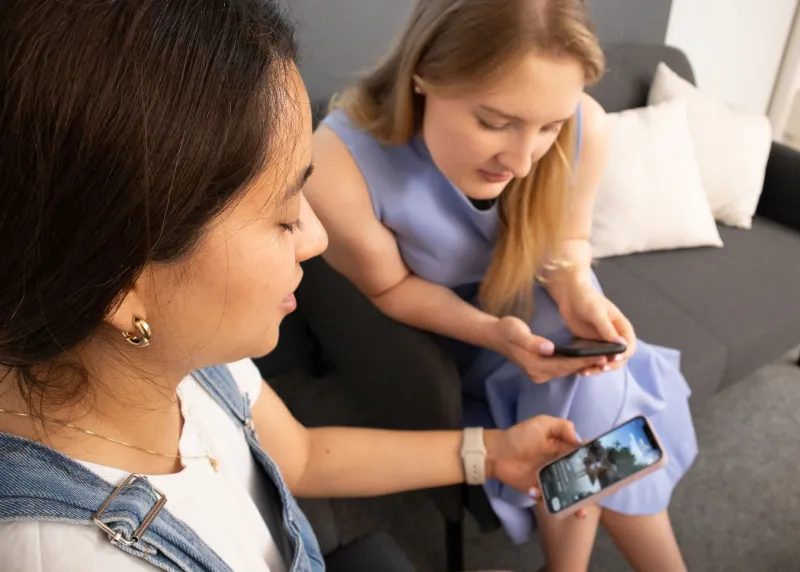
Short-form video has become the most-trafficked Chamorro classroom on earth, and most of the teaching happens in fifteen-second bursts delivered by people under thirty. Pronunciation drills filmed in parked cars. Slang explainers stitched over clips from family parties. Duets where a grandmother in Kagman corrects a granddaughter in Sacramento and the correction picks up twenty thousand likes.
For a language that has been flagged as vulnerable for years, with fluent speakers skewing steadily older, the pocket classroom is not a small thing. For a lot of diaspora kids, it is the only thing.
The lesson plan is a phone
Ask these creators why they started and the answer is almost always a specific relative. One Guam-born nurse in Las Vegas began filming pronunciation videos because her father's illness was taking his English before his Chamorro, and she wanted the sound of the language in her own mouth before it went anywhere. A Saipan-raised high schooler built an audience on ordinary household commands — sit down, come here, stop that, you are going to get it — the phrases that show up at volume in a real house and never in a textbook. A Carolinian-Chamorro creator runs a Reels series on the two indigenous languages that share Saipan and almost no vocabulary, and the comments are half gratitude, half people realizing how little they knew about their own backyard.
The format does work that worksheets cannot. It is repetitive without being punishing. It is face to face — a real mouth shaping a real word — which is how human beings learn to pronounce anything. And the comment section doubles as office hours. Ask how the å in “maolek” actually sounds and somebody answers, usually within the hour, sometimes a stranger, sometimes an auntie, sometimes both.
The spelling fight in the replies
This is where it gets interesting. The most heated threads on these accounts are not about vocabulary. They are about letters.
Written Chamorro in the Marianas has spent decades being standardized, revised, and argued over — the å, the ñ, the glottal stop that lives as an apostrophe and vanishes the moment somebody types fast. Add the CHamoru versus Chamorro spelling question on top and you have a subject capable of turning a cooking video into a referendum.
Young creators tend to make a practical call: spell it the way it sounds so a beginner can read it out loud tonight. Elders tend to hear that as the language going soft at the edges. “If we lose the å, we lose the word,” one longtime language teacher on Saipan told me, and she was not really talking about diacritics. She was talking about the difference between teaching somebody to say a thing and teaching them to say it right.
The better young accounts have absorbed that criticism instead of arguing with it. Several now run a correction segment. A few pin a comment explaining the orthography before anyone can complain about it. The tone stays playful — this is a short-video platform, not a linguistics seminar — but the standard is quietly rising, and the reason is not the algorithm. The reason is that the elders are watching, and the creators know it.
What a screen cannot do
The honest problem is fluency. There is a wide gap between recognizing a word in a video and producing it in a kitchen while your grandmother waits. Passive learning flatters you. You can watch forty clips about greetings and still freeze when an elder walks through the door.
Creators talk about this constantly, and the serious ones treat the platform as a funnel rather than a finish line. Some link to in-person classes. Some push immersion camps and parish language nights. A few have started assigning homework that requires a phone call to a relative — call your nana, ask her this question, record the answer, come back and tell us what she said. That assignment does more for the language than a thousand duets, because it moves the lesson off the glass and into a living room.
Then there is the platform problem. Every creator I spoke with understands that they are building a language archive on rented land. Sounds get muted. Accounts get throttled. Formats fall out of fashion. A generation's most visible teaching is happening on apps that could rewrite their rules next quarter, and the diaspora has not yet built a durable, searchable, offline copy of any of it. That is the project nobody has funded.
Still, the phone is a door
Here is what the phone has genuinely changed: it made the language audible again, on demand, for people who live seven thousand miles and three generations from the last fluent speaker in their family. Kids who used to hear “Håfa Adai” only at funerals now hear it on a Tuesday, while drying dishes, for no reason at all. That is not fluency. It is the beginning of wanting it.
The young creators seem to understand the assignment better than the discourse gives them credit for. They are not trying to replace the classroom. They are trying to get people to walk into one — a real room, with real elders, where the å gets corrected to your face and the food comes afterward.
Which, honestly, is how this language has always travelled.