The Court Lights Stay On: How Saipan Turns a Chain-Link Rectangle Into a Village Living Room
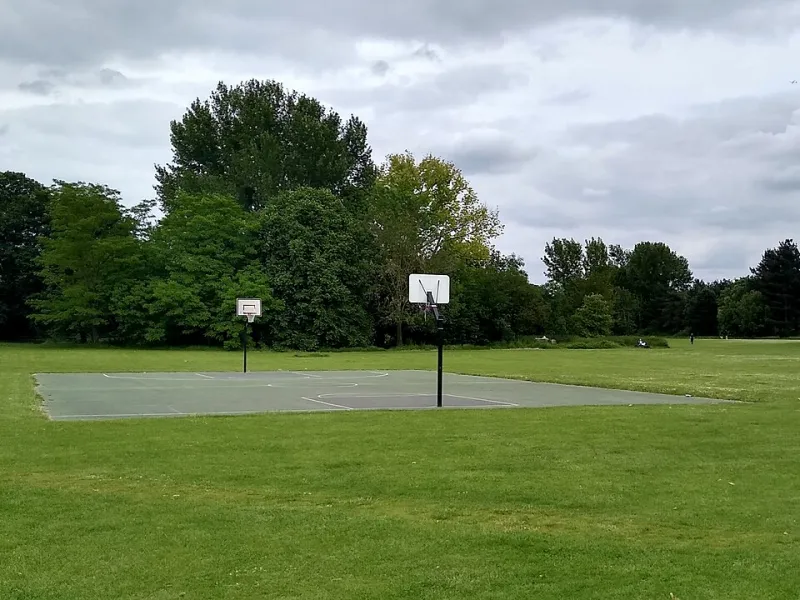
Photo: Mertbiol, CC0, via Wikimedia Commons
The lights click on before the heat fully leaves the pavement. First comes the sound of a ball bouncing alone—someone working on a jump shot, maybe a kid who got there early to claim the good rim. Then the bikes, the scooters, the aunties in folding chairs, the cooler of drinks, the cousin who was supposed to be home an hour ago. By the time the first real game starts, the court has already become something more than a court.
On Saipan, outdoor basketball courts function like the island’s real town square. They are where village leagues overlap with pickup runs, where teenagers get watched by somebody’s uncle, where news travels faster than a group chat, and where a final buzzer doesn’t actually end the night. People stay. They talk. They eat. They wait for the next game.
That’s the part mainland towns keep missing when they build a court and call it done.
The 6 P.M. Migration
Saipan’s court culture follows the weather and the workday. Late afternoon and early evening are the sweet spot—still light enough to see, finally cool enough to move. In villages like Chalan Kanoa, Susupe, Koblerville, Kagman, and Garapan, the court becomes a gathering point without anybody sending an invitation.
Some nights it’s a full-court run with high schoolers and twenty-somethings. Some nights it’s half-court, three-on-three, and a lot of arguing about whether the ball went off the foot. Some nights it’s mostly kids, with a few older players teaching by correction: elbow here, feet there, don’t reach, box out.
The games are not always organized. That’s the point. A court that only works when a league is scheduled is a facility. A court that works on a random Tuesday because people know to show up is a community space.
Pickup Rules, Island Version
If you’ve played pickup on the mainland, you know the basic grammar: call your own fouls, winners stay on, don’t be the guy who never passes. Saipan’s version has its own accents.
You might see a younger player get pulled into a game with adults who are clearly better and clearly willing to coach. You might see a teenager sit out a possession because an elder is talking. You might see a disagreement resolved with a laugh before it becomes a thing. And you might see somebody’s little brother running loose near the sideline while three different people keep an eye on him.
The court has a hierarchy, but it’s not only about age or skill. It’s about respect. If you’re new, watch a game first. Ask if you can run. Don’t assume the ball is yours. And if you get beat, don’t take it personally—everybody gets beat on a court with this many people who have been playing together since elementary school.
A Bulletin Board With a Jump Shot
Stand near a Saipan court for an hour and you’ll learn things. Who’s having a family party. Whose car is finally running again. Which village league game got moved. Who needs a ride to practice. Which store has ice. Which auntie is looking for her nephew. Which nephew is pretending he didn’t hear.
This is the part that doesn’t show up in a rec department brochure. The court is a news exchange. It’s a place where information moves through people, not notifications. A text can be ignored. A message relayed by three guys at the free-throw line has a way of finding you.
It’s also a low-stakes place to be known. You don’t have to be the best player. You don’t have to be outgoing. You just have to show up enough that people recognize your face and know where you fit.
The Babysitting Network
Here’s a scene that plays out on courts across the island: a parent has errands, an older sibling has practice, a younger kid needs somewhere to be. The court absorbs them.
Not officially. Not through a program. It just happens. A kid shoots on a side hoop. An auntie tells them to drink water. An older player makes sure they don’t wander into the road. Somebody’s cousin buys an extra bag of chips. The court becomes a supervised space without a sign-in sheet or a liability waiver.
That kind of informal care is hard to measure, which is probably why it gets overlooked. But ask any family that has relied on it. The court is not just where kids play. It’s where kids are seen.
The Mentorship Is in the Reps
The best youth program on a Saipan court might not have a name. It looks like an older player correcting a younger one’s footwork. It looks like a captain telling a hothead to calm down. It looks like someone handing a kid a water bottle and saying, “Run it again.”
On the mainland, we tend to formalize mentorship. We create clinics, leagues, and eight-week curricula. Those things matter. But they can’t replace the daily, unglamorous presence of adults who show up on the same court at the same time and expect the next generation to show up too.
A court with lights and a regular crowd does something no app can do: it creates repetition. You see the same people. You learn the same standards. You get better because somebody notices when you don’t.
What Mainland Towns Keep Forgetting
A lot of American towns have basketball courts. Fewer have courts that function as public living rooms. The difference is rarely the rim or the backboard. It’s the basics around the edges.
Lights. Benches. Shade. Water. A trash can that gets emptied. A surface that doesn’t turn into a hazard after rain. And most importantly, permission for people to be there without buying something.
Saipan’s courts work because they are embedded in the neighborhood. They are near homes, not tucked behind a rec center with a parking lot and a closing time. They are used by every generation, not reserved for one age group. They are loud enough to matter and open enough to include the kid who isn’t on a team.
That’s a lesson worth stealing: community space doesn’t need a grand design. It needs consistency, safety, and the understanding that a court is not a product. It’s a place.
Show Up and Watch
If you’re visiting Saipan and you love basketball, don’t just drive past the court and take a photo. Stop. Ask if you can watch. If there’s room in a game and you’re invited, play. If not, sit on the sideline and learn the rhythm.
Stay past the final buzzer. That’s when the court shows you what it really is. The players cool down. The aunties pack up. Somebody rewrites the odds for tomorrow. A kid keeps shooting until it’s actually dark. The lights stay on a little longer than they need to.
That’s not inefficiency. That’s the whole point.